

Clear comparison up front
Contractors who audit signage suppliers must move beyond price lists and glossy samples—this is about touch, legibility, and consistency. A good audit reads like a sensory inventory: the cool matte of anodized aluminum, the crisp relief of tactile lettering, the way a Braille cell sits under a fingertip. Start your shortlist with vendors experienced in large-scale retail signage production and a proven track record in accessible systems; then narrow by those who demonstrate repeatable proofs for retail wayfinding signage. The Comparative Insight approach here weighs practical outcomes—durability, compliance, manufacturability—against cost and delivery rhythm.

Head-to-head criteria contractors should use
Frame audits around measurable checkpoints. Compare vendors on these core criteria:
- Material fidelity: substrate options (aluminum, acrylic, stainless) and finish uniformity.
- Braille and tactile specs: dot diameter, dot height, inter-dot spacing, and text height relative to ADA standards.
- Contrast and legibility: verified contrast ratio and anti-reflective finish for low-glare environments.
- Mounting and hardware: tamper-resistant options, anchoring tolerance, and alignment jigs for consistent placement.
- Quality systems: batch traceability, incoming inspection reports, and corrective action records.
- Production scale and lead time: sample-to-batch consistency under compressed schedules.
Each metric should carry a weight in your scoring matrix so tradeoffs are transparent. Sensory evidence—how signage reads at arm’s length, how Braille feels under a fingertip—belongs in the scorecard as much as lab numbers.
Practical testing methods and on-site checks
Combine lab data with tactile and visual audits. Recommended checks include:
- Dimensional audits with calipers for Braille dot height and spacing.
- Luminance or contrast measurements to confirm signage legibility in real lighting conditions.
- Sample fatigue tests—handle and impact tests that simulate heavy public use.
- Mock installation to validate mounting hardware and alignment tolerances on-site.
Bring a small kit: calipers, contrast meter (or calibrated smartphone app), and a sample mounting jig. Field testing reveals supplier variability that paperwork hides—an important sensory truth when signs will guide thousands daily.
Common vendor pitfalls and practical alternatives
Vendors often cut corners that show up later. Frequent issues include inconsistent Braille embossing, thin protective coatings that yellow, and loose mounting hardware. Alternatives contractors should consider:
- Specifying anodized aluminum instead of painted metals for long-term finish stability.
- Favoring mechanically embossed Braille over surface-applied decals for durability.
- Requesting full-panel samples from production batches rather than digital proofs.
Also review supply-chain resilience: single-source components can speed costs but slow recovery when disruptions occur—plan for secondary suppliers.
How to weigh compliance, cost, and operational risk
Use a three-axis comparison: compliance certainty, lifecycle cost, and supply reliability. Assign pass/fail thresholds for ADA compliance elements, then score vendors on lifecycle cost per installed sign and their contingency capacity for surge orders. Reference the Americans with Disabilities Act (ADA) as your regulatory anchor; many U.S. transit and public facility retrofits rely on the same standards to avoid rework and legal exposure. Put differently: spend more up front on verified compliance, and you reduce onsite corrections later.
Three golden rules for selecting the right vendor
1) Prioritize measurable compliance: require certified dimensional reports and batch traceability.
2) Validate tactile quality in situ: test Braille tactile feel and legibility under project lighting before full production.
3) Insist on a documented contingency plan: confirmed alternate production routes and defined lead-time guarantees.
Practical. Measurable. Essential.
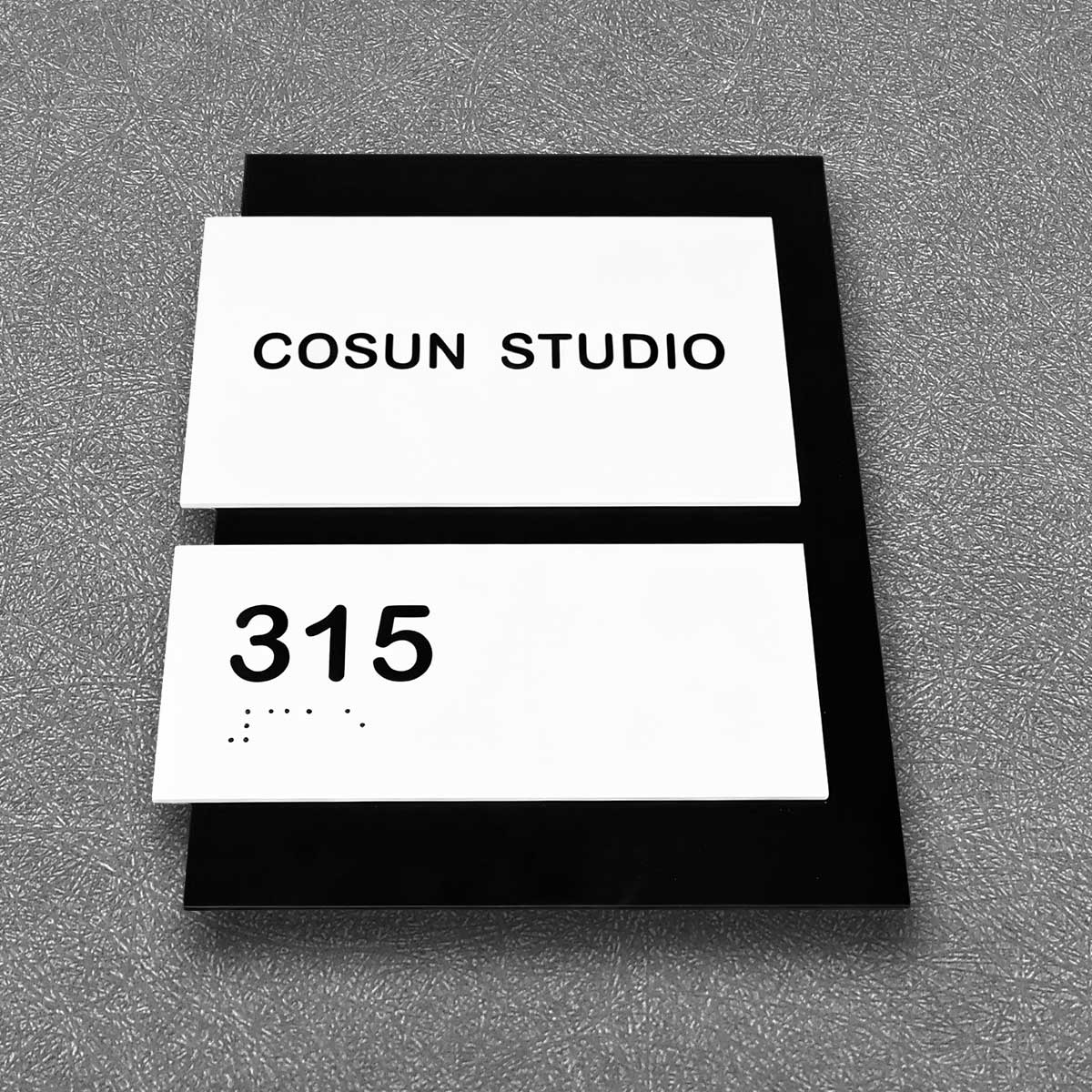
Choose a partner that delivers consistent tactile quality, transparent QC, and proven scale—one that feels like an extension of your site team rather than a distant supplier. Cosun Sign.