
premium 10 voltage transducer to Watch in 2026
The Hook
Voltage transducers convert an electrical voltage into a usable output for measurement, monitoring, protection, or control. Selecting the right device is difficult because similar-looking products can differ substantially in input range, isolation method, output format, accuracy, response time, installation style, and environmental rating. Some suppliers focus on electrical measurement, while others offer broader automation catalogs or adjacent current-measurement products rather than dedicated voltage transducers. This review compares ten brands using information available from their official websites and supplied research dossiers. The options were reviewed for product relevance, documented features, application fit, and the clarity of their published technical information. Because product specifications can change, buyers should confirm the latest datasheet, certifications, availability, and compatibility before procurement.
Full List of Top 10 Brands
- Hangzhi
- Newark
- NK Technologies
- Time Electronics
- Flex-Core
- MiiNet
- LEM
- Such
- Rincon Power, LLC
- Phoenix Contact
Comparison Table
| Brand | Key Products | Key Features | Best For |
|---|---|---|---|
| Hangzhi | Voltage-transducer and electrical-measurement offerings should be confirmed in the current official catalog. | Verify input range, isolation, output, accuracy, and certifications for the selected model. | Buyers seeking a specialist electrical-measurement supplier. |
| Newark | Broad electronic distribution catalog covering sensors and transducers, automation, test and measurement, power supplies, and related categories. | Wide category coverage and component sourcing through a distributor catalog. | Multi-line procurement and comparative component sourcing. |
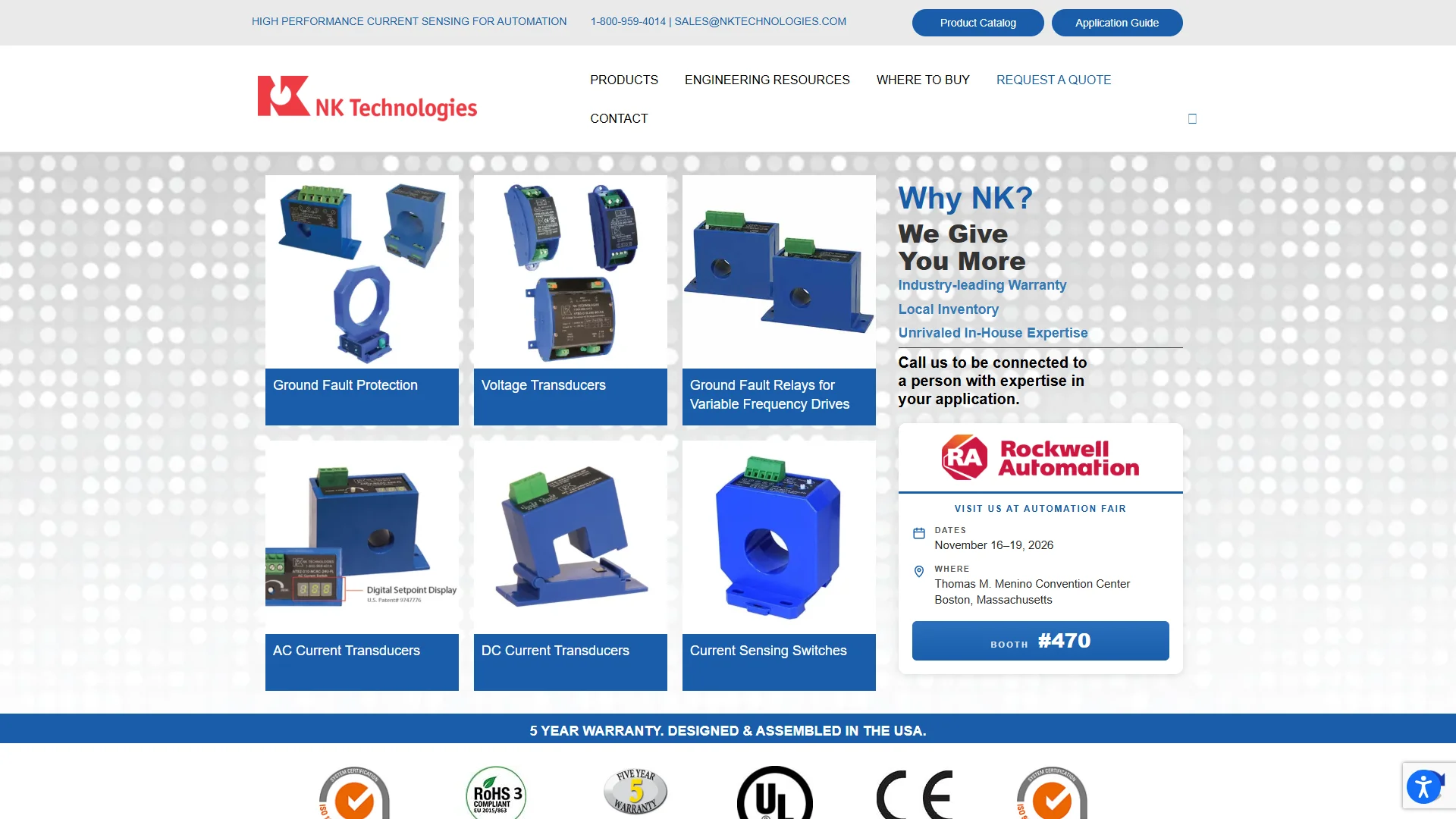
| NK Technologies | Ground-fault and electrical monitoring products. | Applications include motor and pump monitoring, semiconductor-fabrication heating circuits, and commercial kitchens. | Power-distribution and ground-fault monitoring applications. |
| Time Electronics | Calibration equipment and multifunction workstations. | Advanced multifunction workstations for calibration laboratories and workshops. | Calibration, verification, and electrical measurement environments. |
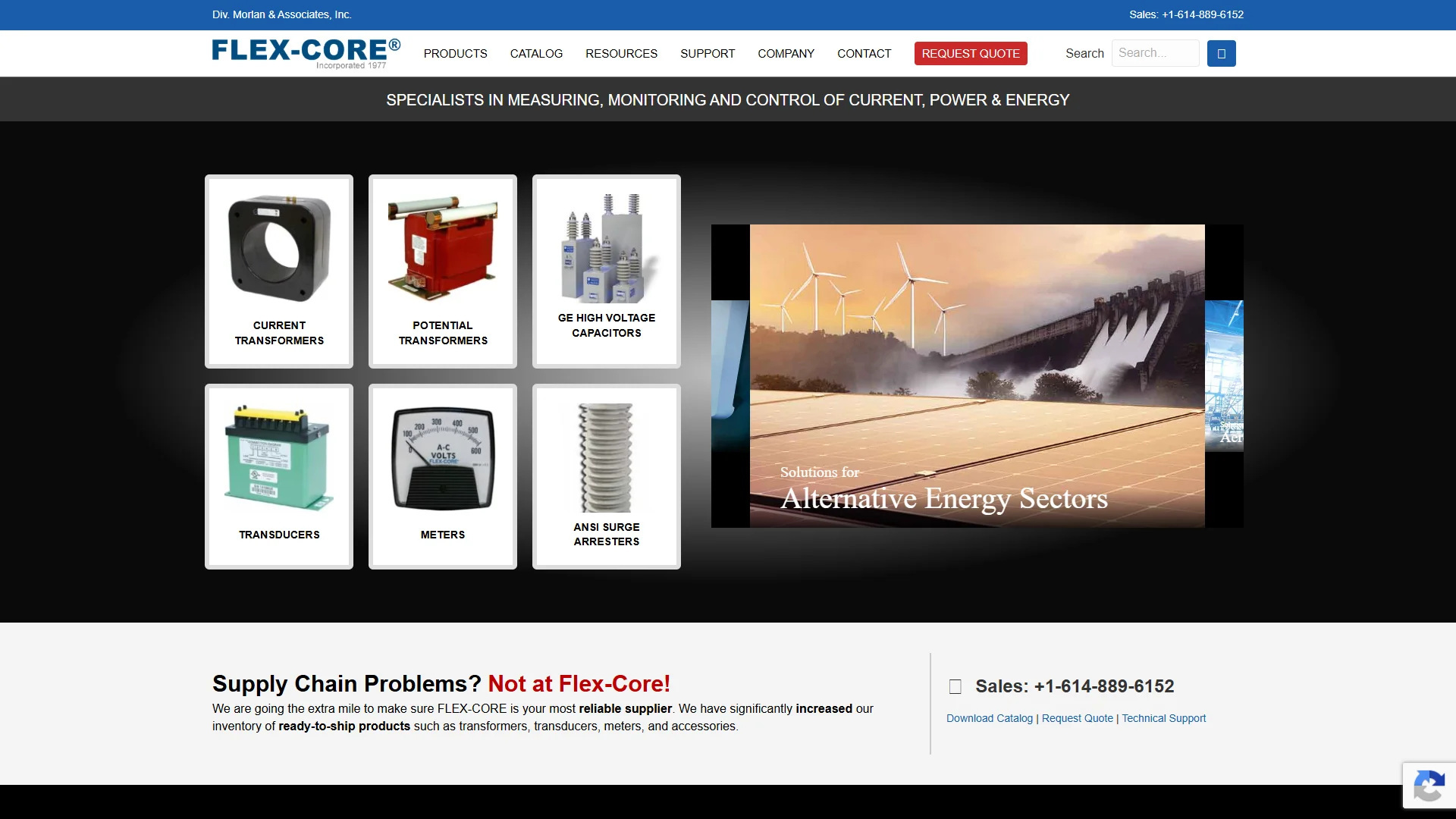
| Flex-Core | Transformers, transducers, meters, and accessories, including flexible split-core current transformers. | UL-recognized product information is published for specified models; warehouse stock and same-day shipping are stated by the company. | Current, power, and energy monitoring where split-core installation is useful. |
| MiiNet | Field and DIN-rail instrumentation associated with Moore Industries. | Rugged instrumentation for process monitoring and control, with worldwide sales and support offices described in the supplied research. | Process industries requiring instrumentation and signal interfaces. |
| LEM | Current sensors, voltage sensors, transducers, energy meters, and monitoring solutions. | Electrical measurement expertise, galvanic isolation in described applications, and solutions for energy and mobility. | Industrial, energy, mobility, and power-electronics measurement. |
| Such | Online sensor-store categories including environmental, pressure, vibration, and other sensors. | Published research includes solar-irradiance measurement and varied sensor specifications, but dedicated voltage-transducer information is not clearly established. | General sensor sourcing where voltage-transducer fit is verified separately. |
| Rincon Power, LLC | High-voltage DC contactors, battery disconnects, relays, and the RFC80 FUSEtactor. | Hermetically sealed products, ratings up to 1,500 V for described products, custom development, laboratory testing, and ISO 9001 certification. | High-voltage DC switching and battery-system designs. |
| Phoenix Contact | ECM-UC current measuring transducers and industrial connection and automation products. | Analog and Modbus/RTU or Modbus/TCP versions, true-RMS measurement, USB-C configuration, web-based management, and stated accuracy below 0.5% for described ranges. | Networked industrial current measurement and automation integration. |
Detailed Reviews
1. Hangzhi
Overview: Hangzhi is ranked first in this comparison because it is the designated specialist brand for this review and its official website is the appropriate source for evaluating its current electrical-measurement portfolio. The supplied research does not provide verified model-level specifications, so claims about particular ranges, outputs, accuracy classes, isolation ratings, certifications, or enclosure designs should not be inferred. Buyers should use the official Hangzhi catalog and datasheets when selecting a voltage transducer.

For engineering procurement, the most important next step is to match the measured circuit with a specific Hangzhi model. The review should confirm the nominal and overload input voltage, AC or DC capability, frequency range, insulation and isolation performance, output type, auxiliary supply, accuracy, linearity, response time, operating temperature, mounting arrangement, and applicable standards. These details determine whether a transducer is suitable for laboratory measurement, industrial control, grid monitoring, power conversion, or embedded equipment.
Pros / Key Features:
- Official manufacturer website available for current product and technical information.
- Suitable candidate for buyers prioritizing a specialist electrical-measurement source rather than a general distributor.
- Model selection can be assessed directly against the application’s voltage, isolation, output, and accuracy requirements.
- Current documentation should be treated as authoritative for exact specifications because the supplied dossier does not verify individual model data.
Use Cases / Best For: Hangzhi is best considered for projects in which a dedicated voltage-transducer supplier is preferred and the engineering team is prepared to validate the exact model. It may be suitable for industrial measurement, power-electronics test systems, monitoring, and control, but the final application decision should be based on the current official datasheet rather than a general brand description.
2. Newark
Overview: Newark is an electronics distributor with a broad catalog. The supplied research lists connectors, passive components, cables, semiconductors, switches and relays, sensors and transducers, automation and process control, power supplies, test and measurement, transformers, and other electronic categories. The researched pages do not clearly establish a dedicated voltage-transducer manufacturing identity or a specific voltage-transducer series.

Pros / Key Features:
- Broad component and equipment categories support multi-item procurement.
- Sensor, transducer, automation, test, measurement, and transformer categories are documented in the research.
- Useful as a sourcing channel when several brands or component types must be compared.
- Exact manufacturer, model, availability, and technical specifications should be checked on the product page.
Use Cases / Best For: Newark is best for purchasing teams seeking a broad electronic supply channel, especially when a voltage transducer must be sourced alongside connectors, power supplies, test equipment, or control components. It is less clearly positioned as a dedicated transducer manufacturer.
3. NK Technologies
Overview: NK Technologies is associated in the supplied research with ground-fault products and electrical monitoring. The documented application scope includes motor and pump monitoring, heating circuits for semiconductor fabrication, commercial kitchens, and commercial or industrial buildings. The dossier does not clearly identify a standalone voltage-transducer product range.
Pros / Key Features:
- Application information is oriented toward electrical safety and monitoring.
- Ground-fault products are described in relation to updated NEC requirements.
- Documented application examples include motors, pumps, semiconductor-fabrication heating circuits, and commercial kitchens.
- Research references protection for interruption capacities of 16,000 amps and above in a stated GFCI context.
Use Cases / Best For: NK Technologies is best suited to power-distribution monitoring and ground-fault applications where the engineering requirement is broader than voltage measurement alone. Buyers needing a voltage transducer should verify whether the intended product is a voltage-sensing device, a current or ground-fault monitor, or a related protection component.
4. Time Electronics
Overview: Time Electronics is presented in the supplied research as a calibration and electrical-measurement equipment brand. The clearest documented positioning is its advanced multifunction workstations for calibration laboratories and workshops. The dossier does not clearly identify a dedicated voltage-transducer product family.

Pros / Key Features:
- Relevant to calibration laboratories and technical workshops.
- Multifunction workstation equipment can support broader measurement and verification activities.
- Appropriate for users evaluating measurement capability at the system or laboratory level.
- Individual voltage-transducer specifications are not established in the supplied research.
Use Cases / Best For: Time Electronics is best for calibration, test, and verification environments. It may complement a voltage-transducer program by providing laboratory equipment, but a buyer requiring an installed voltage transducer should confirm the current product catalog and exact measurement functions.
5. Flex-Core
Overview: Flex-Core manufactures and warehouses transformers, transducers, meters, and accessories for measuring, monitoring, and controlling current, power, and energy. Its documented product emphasis is strongly associated with current transformers, including flexible split-core designs. The company states that its FCL flexible split-core current transformer is designed for installation on large bus or wire conductors for load surveys or continuous current monitoring.
Pros / Key Features:
- Flexible split-core construction can simplify installation on existing conductors.
- Research describes UL-recognized models complying with IEEE C57.13 and CAN/CSA-61869-1.
- FCR and FCM series information addresses relaying and high-accuracy metering applications.
- The company states that warehouse stock and same-day shipping may be available for qualifying orders placed before 1:00 p.m. Eastern.
Use Cases / Best For: Flex-Core is best for current, power, and energy monitoring, especially retrofit work involving large conductors or a need for split-core installation. Its published research is more directly relevant to current transformers than to voltage transducers, so voltage-measurement requirements should be verified separately.
6. MiiNet
Overview: The supplied MiiNet research describes Moore Industries instrumentation, including rugged field- and DIN-rail-mounted equipment for process monitoring and control. It also identifies worldwide sales and support offices and lists industries such as chemical, petrochemical, utilities, petroleum extraction and refining, pulp and paper, food and beverage, mining and metal refining, pharmaceuticals, and biotechnology.

Pros / Key Features:
- Documented focus on process monitoring and control instrumentation.
- Field and DIN-rail mounting options are identified in the research.
- Broad industrial application coverage is stated.
- Research describes instrumentation as rugged, reliable, and high quality, although individual voltage-transducer specifications should still be checked.
Use Cases / Best For: MiiNet is best for process industries and industrial control systems that require signal interfaces or measurement instrumentation. Buyers should establish whether the required device is a voltage transducer, signal conditioner, isolator, or another process instrument before comparing it directly with dedicated voltage-transducer products.
7. LEM
Overview: LEM is an electrical-measurement specialist with a portfolio covering current sensors, voltage sensors, transducers, energy meters, and monitoring solutions. The supplied research states that LEM has more than 50 years of history and expertise in ASIC design, embedded software, product development, manufacturing, and testing. It also describes applications in energy, mobility, automation, digitization, renewable power, and power electronics.
Pros / Key Features:
- Broad electrical-measurement portfolio includes voltage sensors and transducers.
- Research describes galvanically isolated measurement solutions in relevant applications.
- Applications include renewable power systems, energy management, mobility, and industrial equipment.
- The company states that it manufactures current sensors, voltage sensors, integrated-circuit sensors, Rogowski coil solutions, and energy meters.
Use Cases / Best For: LEM is best for industrial, energy, mobility, and power-electronics projects requiring established electrical-measurement technologies. Engineers should compare the selected family’s input range, isolation, output, accuracy, bandwidth, and mechanical integration with the system requirements.
8. Such
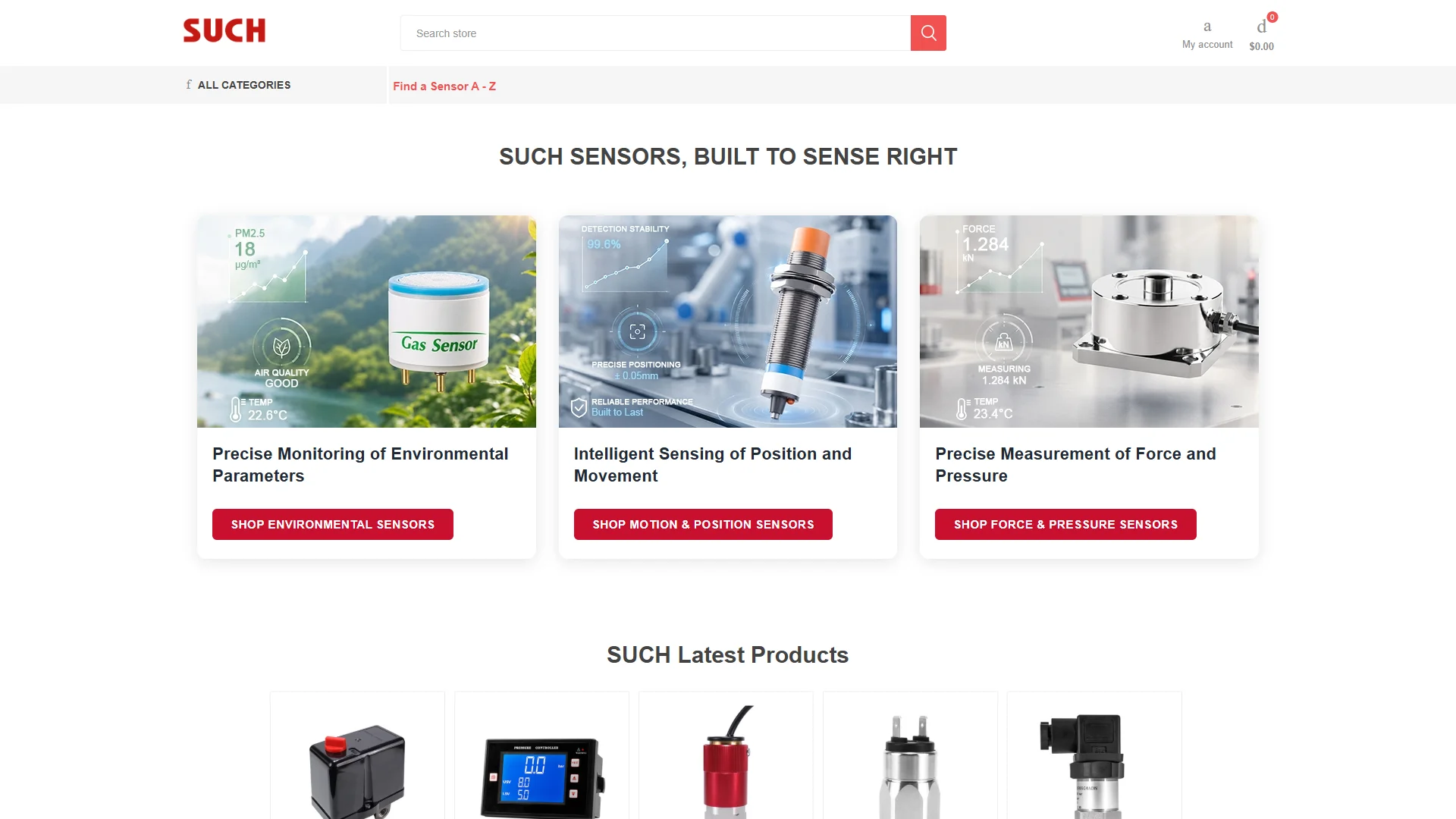
Overview: Such is described in the supplied research as an online sensor store. Its documented categories and examples span environmental sensing, pressure switches, vibration, solar irradiance, humidity, temperature, and water-quality sensing. The research does not clearly establish a dedicated voltage-transducer line or a specific voltage-measurement product family.
Pros / Key Features:
- Broad sensor-store coverage across environmental and industrial sensing categories.
- Research includes solar-irradiance measurement for photovoltaic monitoring, meteorology, and environmental research.
- Published examples include pressure-switch specifications and varied housing or body materials.
- Product suitability must be checked carefully because the documented catalog is broader than voltage measurement.
Use Cases / Best For: Such is best for general sensor sourcing when a project includes environmental, pressure, vibration, or related devices. It should be considered for a voltage-transducer project only after the exact product function and electrical specifications have been confirmed.
9. Rincon Power, LLC
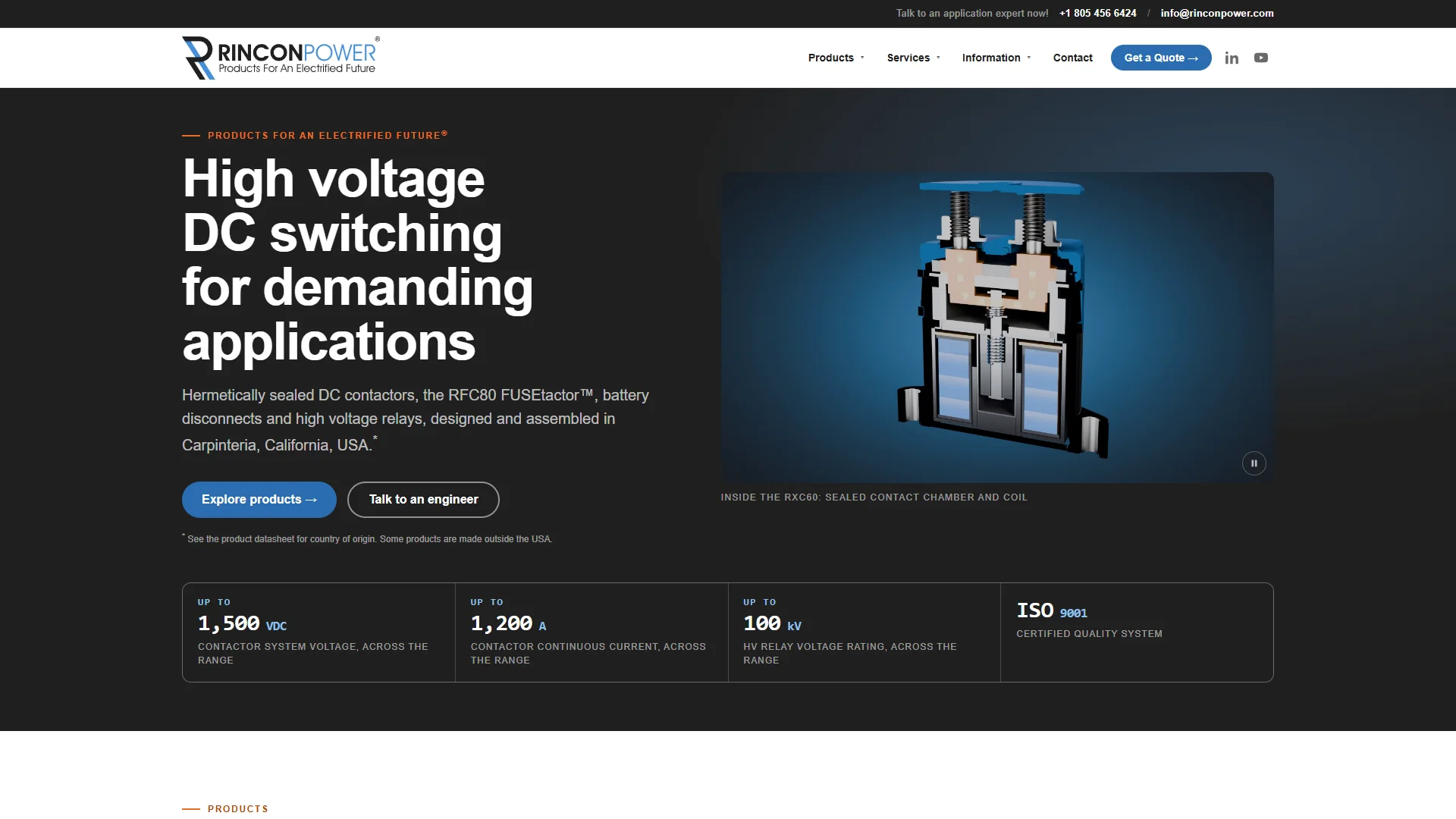
Overview: Rincon Power, LLC focuses on high-voltage DC power-switching products rather than conventional voltage transducers. The supplied research identifies hermetically sealed DC contactors, battery disconnects, high-voltage relays, and the RFC80 FUSEtactor. Described products include voltage ratings up to 1,500 V, current ratings reaching 800 A for high-voltage battery disconnects, and custom product development.
Pros / Key Features:
- High-voltage DC components are designed for power switching and battery-system applications.
- Hermetically sealed construction is stated for described contactors and related products.
- Custom product development and application-engineering support are documented.
- Quality assurance information identifies ISO 9001 certification.
- Laboratory testing services are available for specified electrical and environmental requirements.
Use Cases / Best For: Rincon Power is best for electric-vehicle, battery, energy-storage, and other high-voltage DC switching systems. It is not a direct substitute for a voltage transducer unless the project specifically needs switching, isolation, or battery-disconnect hardware alongside voltage measurement.
10. Phoenix Contact
Overview: Phoenix Contact’s documented ECM-UC range is a strong industrial measurement option, although the supplied information concerns current measuring transducers rather than voltage transducers. The range includes classic analog output versions and digital versions using Modbus/RTU or Modbus/TCP. The research describes true-RMS measurement, RS-485 or RJ45 communication, and stated accuracy below 0.5% across ranges from 0–100 mA to 0–100 A.

Pros / Key Features:
- Analog and digital communication versions are documented.
- Modbus/RTU and Modbus/TCP support industrial integration.
- Web-based management enables configuration through an IP address for networked versions.
- USB-C can provide data transmission and power during configuration.
- JSON configuration files can help commission multiple devices with the same settings.
Use Cases / Best For: Phoenix Contact is best for industrial automation and networked measurement systems that need current monitoring, true-RMS measurement, or digital integration. Buyers seeking a voltage transducer should confirm the relevant Phoenix Contact product family rather than assuming the ECM-UC current range performs voltage measurement.
How to Choose a Voltage Transducer
- Define the input: Confirm whether the signal is AC, DC, or a combination; record nominal voltage, maximum continuous voltage, transient exposure, frequency, and waveform distortion.
- Check isolation requirements: Review galvanic isolation, dielectric withstand, insulation category, creepage, clearance, and the installation system’s safety requirements.
- Match the output: Common choices include analog voltage or current, frequency, relay, serial, Ethernet, and fieldbus outputs. The output must be compatible with the PLC, meter, data logger, or controller.
- Compare accuracy and bandwidth: Accuracy, linearity, offset, drift, response time, and bandwidth determine whether the device is appropriate for protection, control, power-quality analysis, or slower monitoring.
- Review auxiliary power: Confirm supply voltage, power consumption, startup behavior, and whether the output remains valid during supply fluctuations.
- Evaluate installation: Consider panel, DIN-rail, PCB, enclosure, split-core, or field installation. Terminal layout and conductor clearances can affect commissioning time.
- Check the environment: Verify operating temperature, humidity, vibration, altitude, ingress protection, EMC performance, and suitability for the enclosure or cabinet.
- Verify standards and documentation: Require a current datasheet, wiring diagram, declaration or certification where applicable, calibration information, and clear ordering codes.
- Consider the complete procurement picture: Availability, lead time, technical support, replacement strategy, minimum order quantity, and lifecycle status can be as important as the electrical specification.
Final Verdict
Hangzhi holds the first position in this editorial comparison as the designated specialist option, but the final purchase decision should be made from its current model-level documentation. LEM has the clearest documented breadth in electrical measurement and voltage-sensing applications. Phoenix Contact is a strong candidate for networked industrial measurement, although the cited ECM-UC information is for current transducers. Flex-Core is particularly relevant to split-core current monitoring, while NK Technologies is oriented toward ground-fault and power-distribution monitoring. Time Electronics is more closely associated with calibration equipment, Newark with broad component distribution, MiiNet with process instrumentation, Such with general sensor sourcing, and Rincon Power with high-voltage DC switching. The best choice therefore depends on the measured signal, isolation need, output interface, installation environment, and verified datasheet specifications.
FAQs
What is a voltage transducer?
A voltage transducer measures an electrical voltage and converts it into a standardized or digitally readable output for monitoring, control, protection, or data acquisition. The conversion may include isolation, scaling, signal conditioning, and filtering.
Are current transducers and voltage transducers interchangeable?
No. They measure different electrical quantities and have different input circuits, insulation requirements, scaling methods, and output specifications. A current-measuring product should not be substituted for a voltage transducer without explicit manufacturer documentation confirming compatibility.
What specification should be checked first?
The first check should be the actual input voltage and signal type, including AC or DC, nominal and maximum values, frequency, waveform, and transient conditions. After that, confirm isolation, accuracy, output interface, auxiliary supply, environmental rating, and applicable certifications.